
Can You Put a Built-In Grill Under a Covered Patio?
Santa Clarita Outdoor Kitchens explains how a built-in grill goes under a patio cover or pergola in Santa Clarita Valley yards — the overhead and side clearances in the maker's manual, outdoor-rated vent hoods, insulated jackets, the vents in the island, and how the cover's own construction shapes the plan.
Bookings aren't open yet. Leave your name and number; your message is recorded, and you'll get one message when a local installer is available.
Outdoor Kitchen Ideas & Guides
The yard as it starts
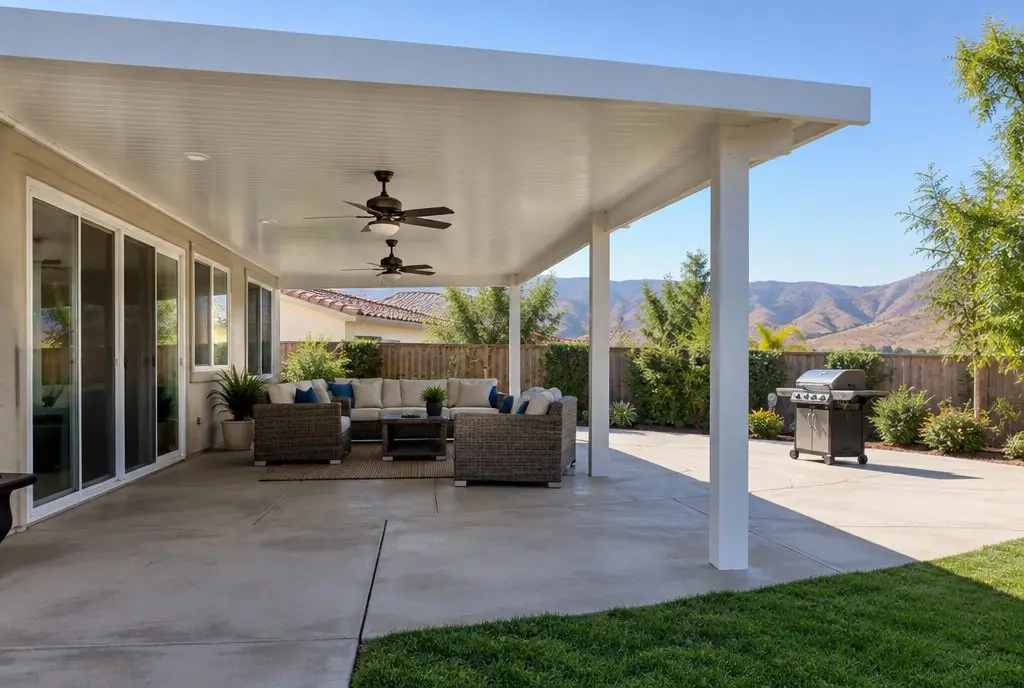 Illustration
The finished kitchen (illustration)
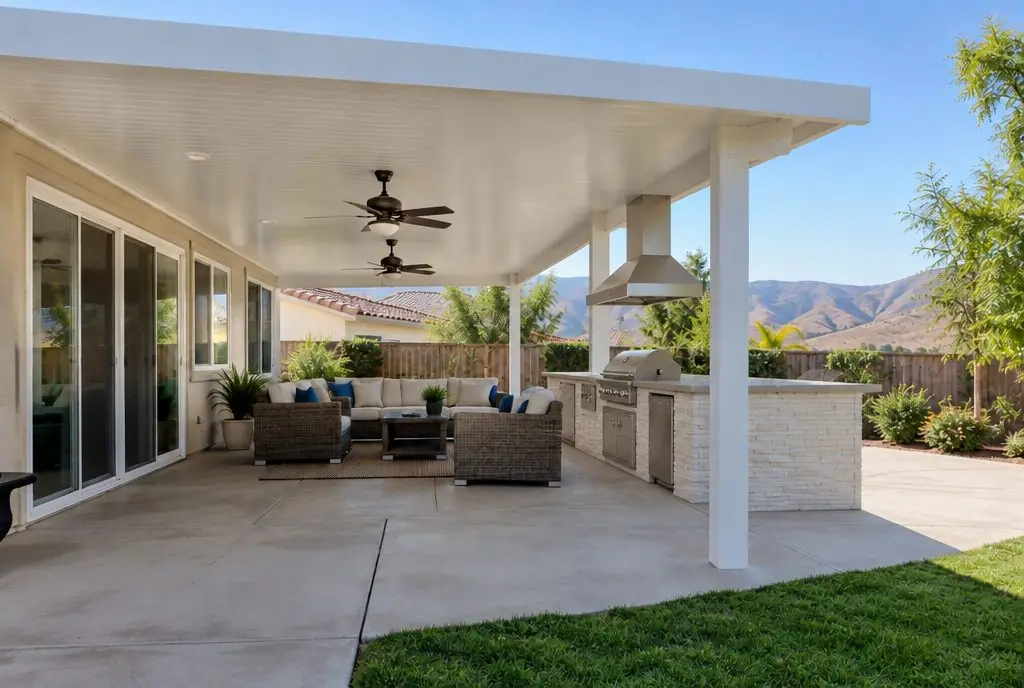 Illustration
Yes, when the clearances and the ventilation are designed in
A built-in grill can go under a patio cover, and in the Santa Clarita Valley it often should: the shade makes summer cooking bearable and keeps the cook with everyone else. A grill under a patio cover or pergola needs the overhead clearance the maker lists, and often a vent hood rated for outdoor use. The design starts with the grill's installation manual and the cover's construction, not with the island's look.
Under a roof, the clearances and the hood decide where the grill goes, and the rest of the island follows.
Clearances: overhead, behind and to the side
Every built-in grill has a minimum clearance to combustible materials in its installation manual. Under a cover, three distances matter: from the cooking surface up to the ceiling or beams, from the back of the grill to the house wall or a post, and from the sides to anything combustible. A wood patio cover or pergola counts as combustible; a cover with a noncombustible ceiling changes the numbers but not the need to check them.
| Situation | What sets the clearance | Typical solution |
|---|---|---|
| Solid wood patio cover | maker's overhead clearance to combustibles | outdoor vent hood, or grill moved to the cover's edge |
| Open pergola with slats | maker's clearance to the beams above | grill placed between beams, hood if the maker requires it |
| Cover with a noncombustible ceiling | maker's clearance to noncombustible surfaces | hood still recommended for smoke and grease |
| Grill near a house wall | maker's rear and side clearances, Zone 0 rules | island set off the wall, grill at the far end |
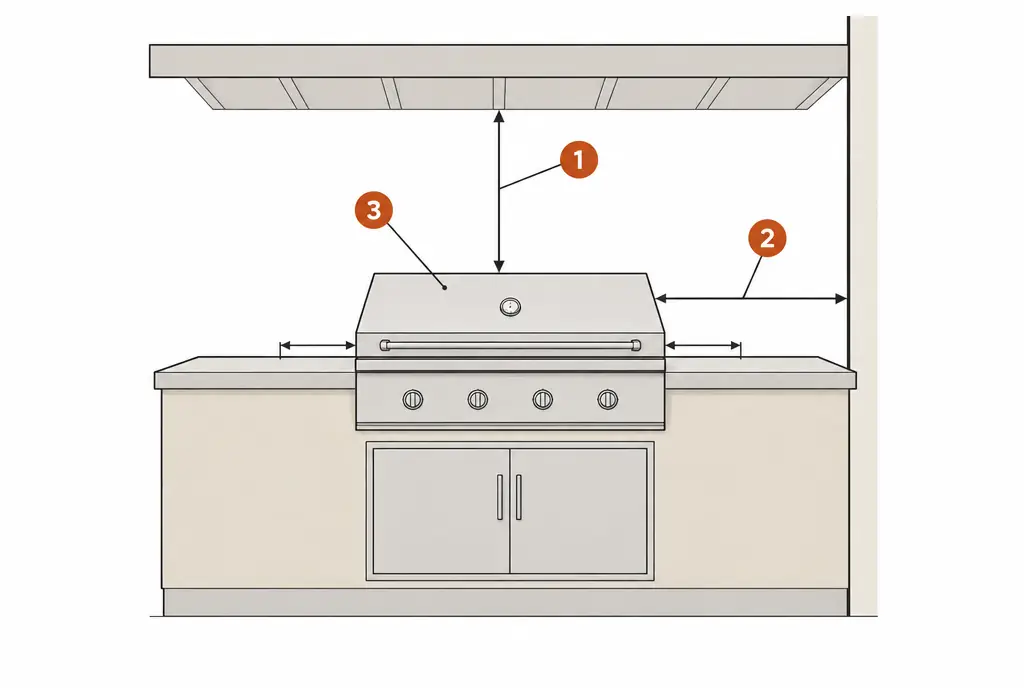
What the numbered markers show
- Overhead: the distance from the grill to the ceiling or beams, the one that matters most under a patio cover or pergola.
- Rear: the distance from the back of the grill to a house wall or a post.
- Side: the distance to the counter ends or any wood trim nearby; every distance comes from the maker's manual for that model, which is why no numbers are printed.
Outdoor vent hoods
Under a cover, smoke and grease collect against the ceiling instead of drifting away. An outdoor-rated vent hood, wider than the grill and mounted at the height its maker specifies, captures them and carries them out through a duct. The duct needs a route through the cover to a roof cap, and the penetration is flashed against rain. Hoods sized for indoor ranges are not a substitute; outdoor hoods are built for the airflow and weather an outdoor grill brings.
Inside the island: jackets and vents
In a wood or other combustible frame, the grill sits in an insulated jacket made for that model. A steel stud frame is noncombustible, but the maker's instructions still decide whether a jacket is needed. An island with a built-in gas appliance needs vent openings in the cabinet, usually on opposite sides, so any leaked gas can escape; the grill maker's installation manual gives the vent size and position.
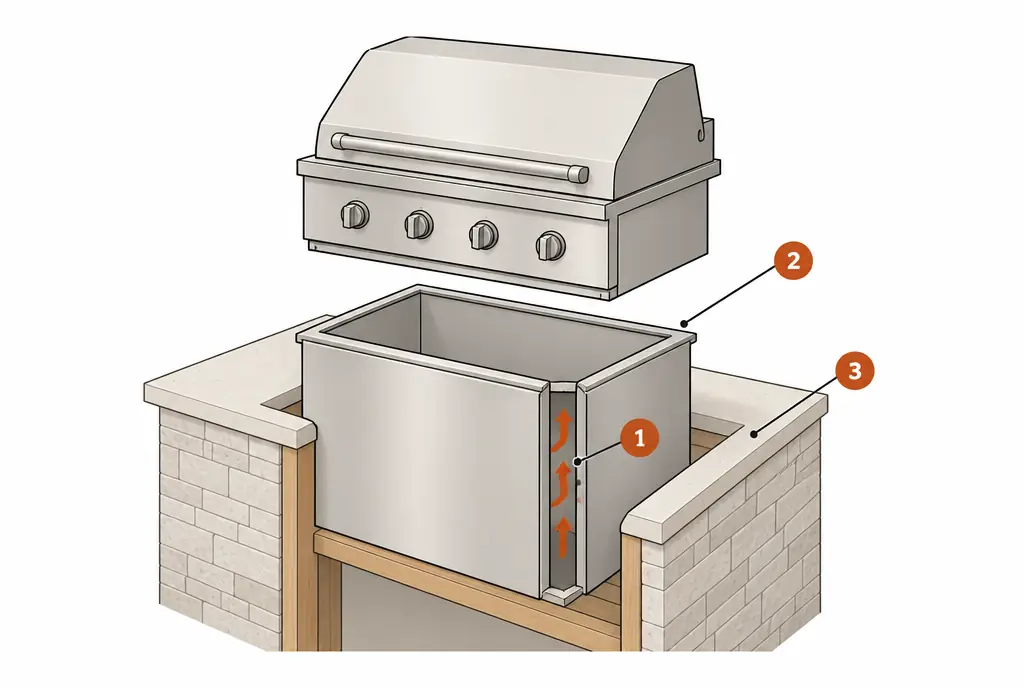
What the numbered markers show
- The jacket is a double-walled liner with an air gap or insulation between the walls.
- The jacket is sized to the specific grill; a jacket from another model does not fit or protect correctly.
- In a noncombustible island frame, the maker's instructions still decide whether a jacket is needed.
When the cover itself is the limit
Some covers are too low for the clearances a grill needs, and some cannot take a duct through the roof. In those cases the grill moves to the edge of the cover, where it is partly outside, or the hood vents sideways if its maker allows it. In Saugus ranch homes with long, low patio covers, setting the grill at the open end of the island is a common answer. A patio cover built at the same time as the kitchen can be designed around the hood from the start.
How a covered grill changes the estimate
A grill under a cover adds the hood, its duct and roof cap, and sometimes an insulated jacket, on top of the island and the grill. The estimator on this page covers the island, the site work and the appliances, and the electrical option covers the circuit a hood needs. Permits for the gas, electrical and hood work, where they apply, are outside the estimator's ranges.
Where this leads
- Service page: Outdoor Kitchen Under a Patio Cover — Shade over the cook and the bar, with the grill clearance, venting and heat planned so the cover survives the kitchen.
- Local page: Outdoor kitchens in Saugus
- All services and typical prices: outdoor kitchen in Santa Clarita
- More illustrated guides: Outdoor Kitchen Ideas & Guides
Check availability and the price range for this setup
Bookings aren't open yet — describe the island and you get a Santa Clarita price range right here. Typical Santa Clarita Valley installed prices for a built-in outdoor kitchen island, structure and countertop, appliances listed separately. This is a market estimate, not a quote. Permit fees, HOA fees and utility company charges, where they apply, are not included.